Blog
The Mothers Who Are Done Whispering


There is a quiet uprising happening in living rooms across America.
It does not look like protest signs.
It looks like women closing doors.
Not slamming them.
Closing them.
Women who have spent decades protecting everyone else’s reputation are beginning to protect their own nervous systems.
Women who were told, “That’s just how they are,” are responding, “That may be. But this is how I am.”
For most of my life, I believed strength meant endurance.
I grew up in a house that cracked but never collapsed — an alcoholic veteran father, a fiery nurse mother, arguments that shook the walls, and laughter that stitched us back together. I learned early how to read moods. How to anticipate tension. How to stabilize instability. I became the emotional engineer of whatever room I walked into.
It worked.
Until it didn’t.
Many women over fifty were trained in the same invisible curriculum:
Keep the peace.
Don’t embarrass the family.
Absorb the insult.
Protect the image.
Stay loyal.
We were told loyalty was love.
But loyalty without reciprocity is self-erasure.
And eventually, something in the body refuses.
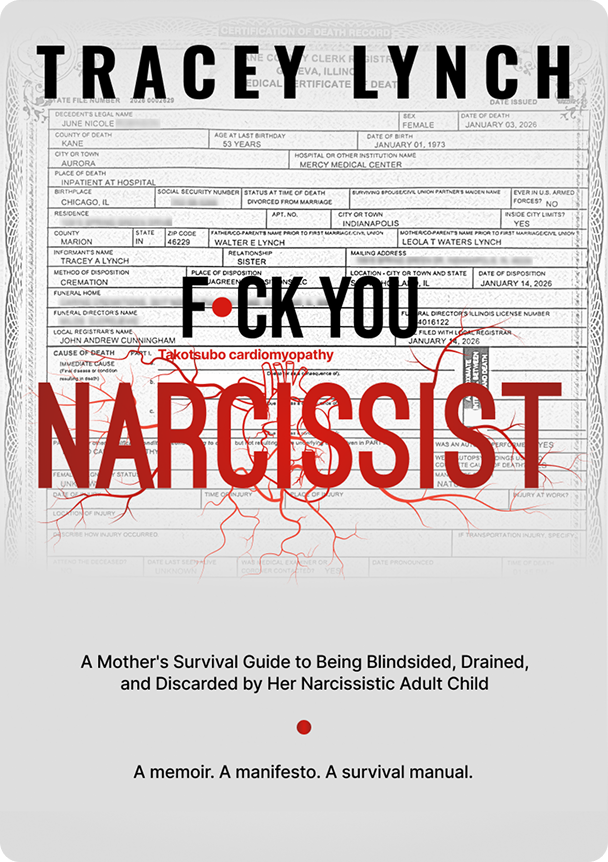
When estrangement entered my life — not as a rumor but as a reality — I did what many mothers do. I blamed myself. I rewrote history in my head. I searched for the flaw in my tone, my timing, my parenting, my boundaries.
Because mothers are trained to ask: What did I do wrong?
We are rarely taught to ask: What was done to me?
There is a particular cruelty in being rewritten as the villain in a story you helped build. And there is a particular silence around it — especially for mothers.
Society has scripts for divorced wives.
Scripts for betrayed partners.
Scripts for grieving widows.
But for mothers discarded by adult children?
We are expected to whisper.
To “give it time.”
To “leave the door open.”
To never defend ourselves publicly.
To absorb the narrative quietly.
I did that for a long time.
Until I realized something profound:
Silence does not equal dignity.
Sometimes it equals fear.
Families are ecosystems. I have written about sustainability for years — soil systems, circular economies, regeneration. But what I did not say directly enough was this:
Some family systems are not sustainable.
Not because they lack love.
But because they lack accountability.
And when accountability is absent, the most conscientious person in the system overcompensates.
Usually, that’s the mother.
We over-function.
We over-explain.
We over-apologize.
We over-endure.
And then one day, we wake up tired in a way that sleep cannot fix.
The mothers who are done whispering are not bitter.
They are conscious.
They are not trying to destroy family.
They are trying to stop destroying themselves.
There is a difference.
This next chapter of my life and writing is not about rage.
It is about clarity.
Clarity that love without boundaries becomes enabling.
Clarity that being discarded does not make you defective.
Clarity that being misunderstood does not require you to shrink.
I am not interested in revenge.
I am interested in truth.
Truth is not loud.
It is steady.
And when women over fifty begin telling the truth about family dynamics — about narcissistic patterns, about emotional manipulation, about being drained and then blamed — something shifts.
We begin to see each other.
We begin to realize we are not isolated failures.
We are participants in generational patterns that were never examined.
The quiet uprising is not dramatic.
It is women deciding:
- I will not defend myself to people committed to misunderstanding me.
- I will not finance my own emotional depletion.
- I will not contort myself to maintain someone else’s comfort.
We are not hardening.
We are recalibrating.
We are not abandoning family.
We are abandoning self-erasure.
And here is what no one tells you:
When you stop whispering, some people will call you difficult.
They will call you dramatic.
They will call you unhinged.
They may even call you narcissistic for finally having boundaries.
Let them.
Clarity threatens systems built on silence.
If you are over fifty and feel something shifting inside you, it is not a midlife crisis.
It is midlife consciousness.
It is the moment you realize endurance is not the highest virtue.
Self-respect is.
And once you taste it, whispering becomes impossible.