Blog
The Grief Tango: Navigating the Surprise of Sister Loss


On grief that cannot be named, the tango I cannot dance forever, and the sister who warned me
There is a piece of me I cannot grasp.
It sits off to my right, diagonally. Not behind me, where the past lives. Not in front of me, where the future waits with its uncertain appointments. Diagonally. Just outside the reach of any direction, I know how to move in. I turn toward it, and it shifts. I try to name it, and the name falls short. I try to hold it in language, and it dissolves into something that language was not built to contain.
I circle this place every day, stepping through a grief tango I never asked to learn. I trace it in my mind the way your tongue finds a sore place in your mouth — not because touching it feels good but because it is there, because it is yours, because something in you needs to confirm that the wound is still real. The circling is not a choice. It is more like weather. It moves through me on its own schedule, arriving when it arrives, and all I can do is be inside it when it comes.
I have been trying to understand what it is, this diagonal thing. And the closest I can come is this: it is the surprise of death. Except that word — surprised — is too small. Too casual. Too easily confused with something manageable. I am not surprised the way you are surprised by an unexpected guest or a check that arrives when you didn’t expect one. I am surprised in the way the ground is surprised by an earthquake: from the inside, without warning, in a place that was supposed to hold.
We all die. I know this. I have known this since I was a child lying in bed at night praying my father would make it home from wherever the drinking had taken him. I have known this through four strokes and a cancer diagnosis and a body count of losses that would undo most people. I have known this since I stood in a room and watched my mother inhale her last breath and leave. I know that we die. I have always known that June could die.
But knowing it could happen is not the same as knowing it would. And that gap — between could and would, between possible and actual, between the world where my sister might die and the world where she did — is where the diagonal thing lives. I understood the could. I did not understand the would. And now I am standing in the would, and it does not feel like a place I was ever prepared to inhabit.
Here is what I want that I cannot have simultaneously:
I want the pain to stop. I want to move through a Tuesday without being ambushed. I want to drive to the grocery store without the grief finding me in the produce section, in the specific kind of laughter coming from two women at the cheese counter, in the song on the radio that she would have known every word to. I want to put this down. It is heavy and I have been carrying it, and I am tired in a way that sleep does not fix.
And I never want time to paint her in a less important place.
That is the grief tango. That is the particular cruelty of mourning someone you loved at the frequency I loved June — you cannot have relief without distance, and distance means she recedes, and receding means the specific weight of her becomes something softer and more general, and I cannot bear the thought of her becoming general. I cannot bear the thought of her becoming a grief I carry lightly. She was not a light thing. She was my Sissy. My Nuna. My first doll. My memory box. The master rememberer of everything I was too busy living to keep careful track of. She deserves the full weight of my missing her. And I also cannot twirl in this tango forever.
So, I circle. And I trace. And I look for the place where I can put this down without putting her down. The place that is not forgetting and not always-remembering. The place where she is kept, perfectly, in the way that matters — not in the sharp daily ache, but in the permanent, structural way, the way a house is kept in you even after you leave it, the way a voice lives in your ear even after the person has stopped speaking. I am looking for that place. I have not found it yet. But I know it exists because I have seen it in movies and on television and in the faces of people who have survived the unsurvivable and come out on the other side holding their grief like something they have finally learned to carry rather than something that is carrying them.
I want that. I am working toward it. And in the meantime, I circle, and I trace, and I let the tango move me because I have not yet found a way to stop it.
I did not need to say things to June.
This is the part that surprised me most — the direction of the hunger. I assumed, in the way you assume these things before you are actually inside them, that what I would miss most was the things I had not said. The conversations left incomplete. The apologies unmade, the gratitude unspoken, the ordinary dailiness of a sister relationship that you never think to document because you assume it will always continue. I thought I would be haunted by my own silence.
But what haunts me is hers.
Not the silence of death — that I expected, as much as you can expect any of this. What haunts me is the particular voice I will not hear again: the unencumbered June. The June who was not captured by her own grief, not dimmed by the depression that settled into her like a long-term tenant, not muffled by the addiction that turned her laughter quieter and her eyes less lit and her voice into something that was still her voice but with something missing from it, the way a song is still a song when played in a minor key but the whole feeling of it has changed.
I needed the earlier version to show up one more time. The June who remembered everything. The June who called on the right days and said the irreverent thing that was also the sacred thing, who could locate me in the fog of my own mind and speak me back to myself. The June who had not yet been worn down by the years of waiting for children who were not coming, who had not yet had her heart broken past the point where hearts can repair themselves.
She did talk to me. In the last months she did let me know. She told me that death was on her mind. She told me this twice. And both times I was standing in my kitchen, over the sink, phone propped up on my windowsill, and the words arrived like words in a language I almost spoke — I could hear them, I could parse them, but something in me refused to let them land with the full weight they carried. Maybe I didn’t take death seriously. Maybe I heard her and believed in the possibility of it without believing in the imminence of it. Maybe I thought there was still time for the unencumbered June to resurface, that if I kept reaching, she would still be reachable, that the woman who warned me death was on her mind was not the same as a woman who was going to die.
She was standing at the sink, too. In her own way. Telling me the water was rising. And I listened. And I did not understand.
Here is what I know that I did not know before June died:
She was the warning I needed to live.
Not the warning she gave me — the two phone calls, the words over the sink, the death she let me know was coming. But the warning her death itself became. The lesson written in the fact of it. The handwriting on the wall that I can read now that the wall is all that is left.
June did not fight. That is the unbearable truth of it. She had been so ground down, so slowly and so completely, by the forces that surrounded her — the children who did not come, the heart that broke too many times without being mended, the body that absorbed grief until it could not absorb any more — that by the end, the fight had gone out of her. She did not die violently. She died the way a candle dies when the wax runs out: not extinguished, just… finished. Used all the way up in the service of a warmth that no one was there to receive.
I am not going to die that way.
I feel it like a vow in my body — not a thought, not a decision made in the reasonable part of my mind, but something more animal and more absolute than thought. June’s death reached into me and rearranged something. She inspired me to do better in my mind and my body in the only way she had left to inspire me: by showing me what it looks like when a woman stops fighting, so that I would know what fighting for my own life looked like, so that I would choose it, so that I would keep choosing it on the days when choosing it is hard.
If death wants my ass, he is going to have to work for it. He is going to find me on a walk. He is going to find me in the garden with dirt under my nails. He is going to find me at my desk, writing the book June did not live to read. He is going to find me laughing with my husband in the kitchen, or reading aloud in the evening, or arguing with my dogs about something that matters to them and not to me. He is going to find me alive in the fullest sense, I know how to be alive, because June showed me in her leaving what it costs to stop.
I carry the diagonal thing. I circle the unnamed place. I look for somewhere to put the grief that is permanent without being consuming. I cry at stoplights and in the produce section and over the sink in my kitchen, in the same place where I stood when June told me death was coming and I held the phone and almost understood.
And every day I put my feet on the floor. And I choose the fight she could not finish.
That is what survival looks like when someone you love has already taught you the alternative.
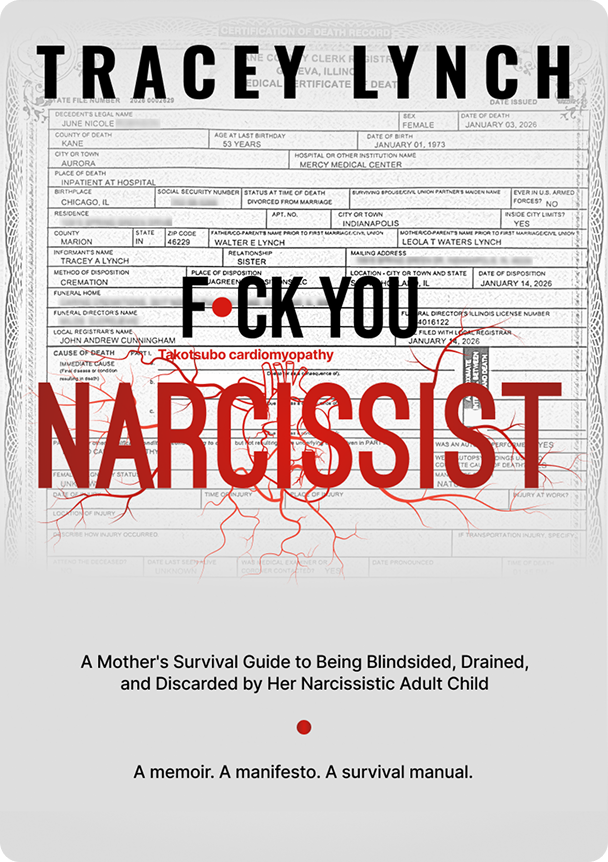
This essay is part of an ongoing memoir series. The full story is told in the forthcoming memoir Fuck You Narcissist: A Mother’s Survival Guide to Being Blindsided, Drained, and Discarded by Her Narcissistic Adult Child. Pre-order now.
I write to save the women no one is talking about — mothers quietly erased by their own children.