Blog
Coping With Sibling Loss: Reframing Grief


Her Heart Did Not Give Out
The language we use around loss either opens grief or shuts it down — and I refuse the words they gave me
Content Warning: This essay discusses the sudden death of a sibling and the emotional experience of grief following unexpected loss.
for June Nicole Lynch Robinson — January 1, 1973 — January 3, 2026
They say her heart gave out.
I say it gave in.
I know those two phrases sound like the same thing to most people. But coping with sibling loss has meant spending the months since my sister June died turning them over like stones, feeling the weight difference between them, because they are not the same. Not even close.
Gave out implies failure. Collapse. A body that broke its promise. And I understand why we reach for that language. It is medical. It is clean. It keeps the mystery at a distance and gives grief somewhere rational to stand.
But gave in is a different universe entirely. It suggests a yielding, a release — something held for a long time finally, quietly, let go. And when I sit with the truth of losing June — two days after her 53rd birthday, six years younger than me — that is the word that comes closest to what I feel. Not failure.
A crossing.
Here is what I want you to know about her before I go any further, because she deserves to be known.
June had three adult children she would have died for — and did, in some essential way, live for. She had a laugh that made a room feel chosen. She believed in tenderness the way some people believe in weather: as a reliable fact of the world, present if you waited for it long enough. She had a dream — specific, named, held close — of grandchildren on her knees, of a partnership she had not yet found, of a life still building toward something she could feel but not yet quite reach.
She was not someone who gave up. I need you to know that. She was not finished.
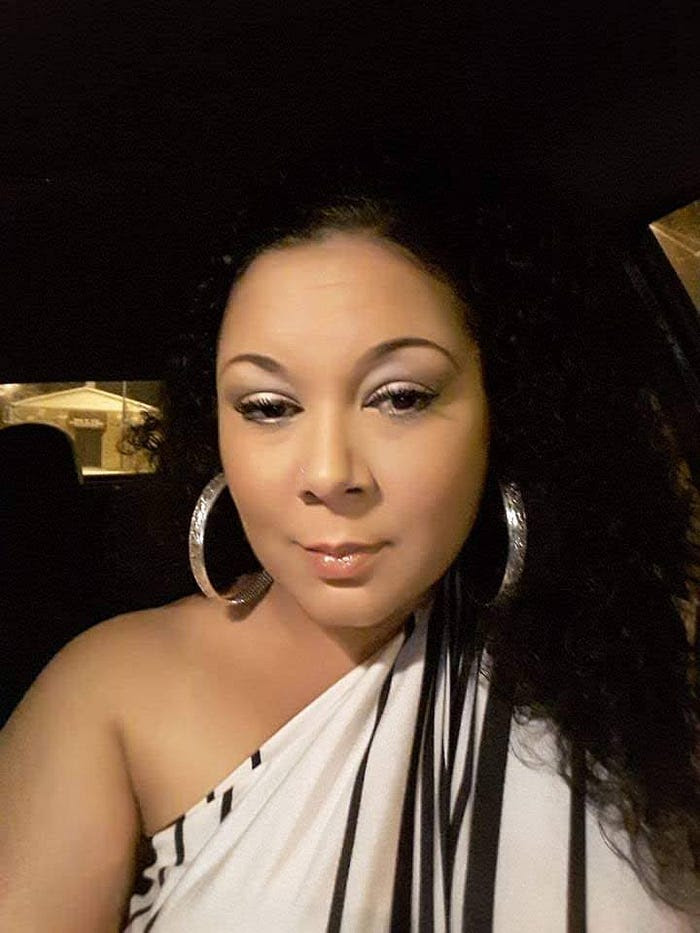
June Nicole Lynch Robinson — January 1, 1973 — January 3, 2026. Photo courtesy of the author.
Which is why the grief that arrived after her death was not the grief I had prepared myself for. I had prepared for sadness. What I got instead was a kind of furious bewilderment — the grief of interrupted trajectory, of a story cut mid-sentence. I kept turning to the next page and finding it blank.
That specific anguish — the it should not have been this way grief — is one we do not always make room for. We talk about loss. We do not talk enough about the loss inside the loss: the future that simply does not get to happen.
There is an unspoken script for grief, and most of us have memorized it without realizing. Shock, denial, bargaining, depression, acceptance — as though sorrow moves in a straight line and eventually deposits you somewhere called okay. I have written about grief before. I thought I understood it in the way you understand something before it personally levels you.
What I did not expect when coping with sibling loss was the loneliness of grieving someone whose death felt cosmically wrong in timing. Not just sad. Wrong. The difference matters, and nobody tells you it exists until you are standing in it.
I also did not expect to find myself in a quiet argument with language itself.
When people said her heart gave out, something in me resisted — not out of denial, not to protect myself from the fact of her death, but because the word failure was embedded in it. And June did not fail. Her body reached a threshold we could not see from the outside. Her heart crossed something we do not have instruments to measure.
Gave in is not a softer word. It is a truer one — for me, for her, for what I believe happened in that space between one moment and the next. I am not asking anyone to adopt my framing. I am asking for permission to hold it. For the conversation around grief to have room for the meanings people reach for when clinical language leaves them cold and alone.
We are nudged — gently, constantly — to process grief efficiently. To name our feelings. To see a therapist. To find closure, as though loss is a chapter with an ending rather than a character that simply moves into the house and changes all the furniture.
I do not believe in closure. I believe in carrying — learning to hold something heavy without being permanently bent by it.
Grief is not a disruption to be managed. It is information. It is the full weight of what someone meant to you, arriving all at once now that they are no longer here to distribute it across daily life. It is love with nowhere immediate to land.
What has helped me is not moving on. It is moving through — which looks, from the outside, sometimes like not moving at all. It looks like saying her name to someone who will let me. Like not rushing to extract a lesson from what happened. Like refusing to tidy the mess of it into something easier to look at.
Real honesty about grief means admitting there is sometimes no insight yet. Sometimes there is only the fact of absence, and the daily decision to keep showing up inside it.
I choose to believe that June has not left the story.
That her love — for her children, for the life she worked toward, for the grandchildren she named in her imagination before they existed — does not end because her heart stopped. Love does not obey those rules. It moves. It shifts form. It turns up in the ache I feel when something funny happens and my first instinct is to call her. It lives in the way I now hold more tenderness for every stranger navigating an ending they never chose.
June was six years younger than me. I was not supposed to watch her go first. But grief, like love, does not ask your permission. It simply arrives and says: here I am. What will you do with me now?
I am still working on that answer.
What I know so far: I will not rush it. I will not package it into something presentable. I will carry her name the way you carry something that is both heavy and irreplaceable — carefully, with both hands, close to the chest.
Her heart did not give out.
It gave in to something larger than what we can see from here. And I am learning — slowly, imperfectly, on the hardest days with considerable effort — to trust that.
Even when I cannot explain why.
Even when the blank page stays blank.
Even then.
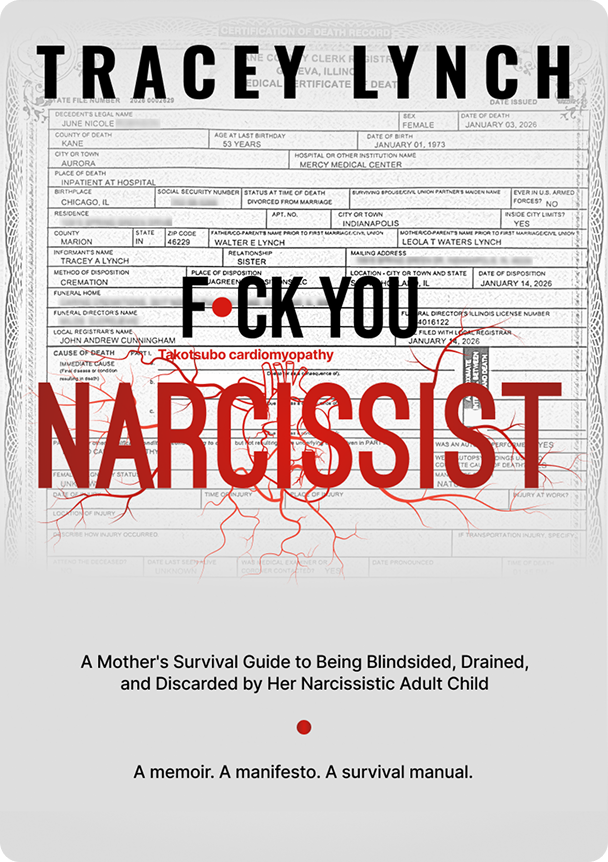
This essay is part of an ongoing memoir series. The full story is told in the forthcoming memoir F*ck You Narcissist: A Mother’s Survival Guide to Being Blindsided, Drained, and Discarded by Her Narcissistic Adult Child. Pre-order now.
I write to save the women no one is talking about — mothers quietly erased by their own children.