Blog
The Kintsugi Family: A war-broken veteran, a hot-headed nurse, and the century-old house that held us together

I was born in 1967 in Aurora, Illinois — the daughter of two Black parents who had migrated north during the Civil Rights era, looking for a life that didn’t require them to drink from separate fountains or step off sidewalks for white folks. My father was a World War II veteran who had served in a segregated Army, fighting for a country that came home and spat on him. He was forty-four years my senior — fifty years old when my baby sister June was born. That’s one reason I didn’t get to have him very long.
My mother was a nurse who worked double shifts because that’s what Black mothers did. They didn’t complain. They provided. I had an older brother — a drummer, gifted a platinum record from Michael Jackson’s Thriller album for his contributions with Quincy Jones. And then, six years after me, came June. The one I would mother before I knew what mothering meant.
I remember my father coming home when I was four years old. He had on a white turtleneck and a black pea coat. He picked me up and swung me through the air in circles, and I felt safe. I felt loved. I felt like the center of the universe. The smell of his aftershave. The roughness of his wool coat against my cheek. The way he laughed — deep and full, like joy had found a home in his chest.
I only learned later where he’d been. He was an alcoholic. The war had broken something in him that America refused to fix. He drank to forget the things he’d seen, the things he’d done, the way his own country treated him when he came home a hero and was still called a nigger.
And I — even at four, at five, at six — learned to pray for him. I would lie in my bed at night, hands pressed together so tight my knuckles turned white, and pray that he wouldn’t be killed drunk driving. I would pray that the arguments with my mother wouldn’t get worse. I would pray for peace in a house that felt like it could crack at any moment.
I learned later that my mother was a hot head. The story goes that while she was in nursing school in the South, the head nurse called her a nigger. The story goes that my twenty-year-old mother jumped over the nursing station and proceeded to beat that nurse’s ass until she was pulled off of her. My grandmother put her on a train that very night. One suitcase. Going north to Chicago. She was never to return to Mississippi anytime soon.
So, these were my parents. A war-broken alcoholic veteran and a hot-headed Southern nurse who had been run out of Mississippi for defending her own dignity. Two people with fire in them. Two people who had been told by the world that they were less than, and who had responded — in their different ways — with their fists. They brought all of that into our house on Spring Street. The drinking and the arguing. The stubbornness and the pride. The refusal to be small. And somehow, in between all of it, they also brought love.
But the house didn’t only crack. It also held us. And I need you to know that — because the world wants to hear only the trauma, and trauma was not the whole of my childhood. Not even close.
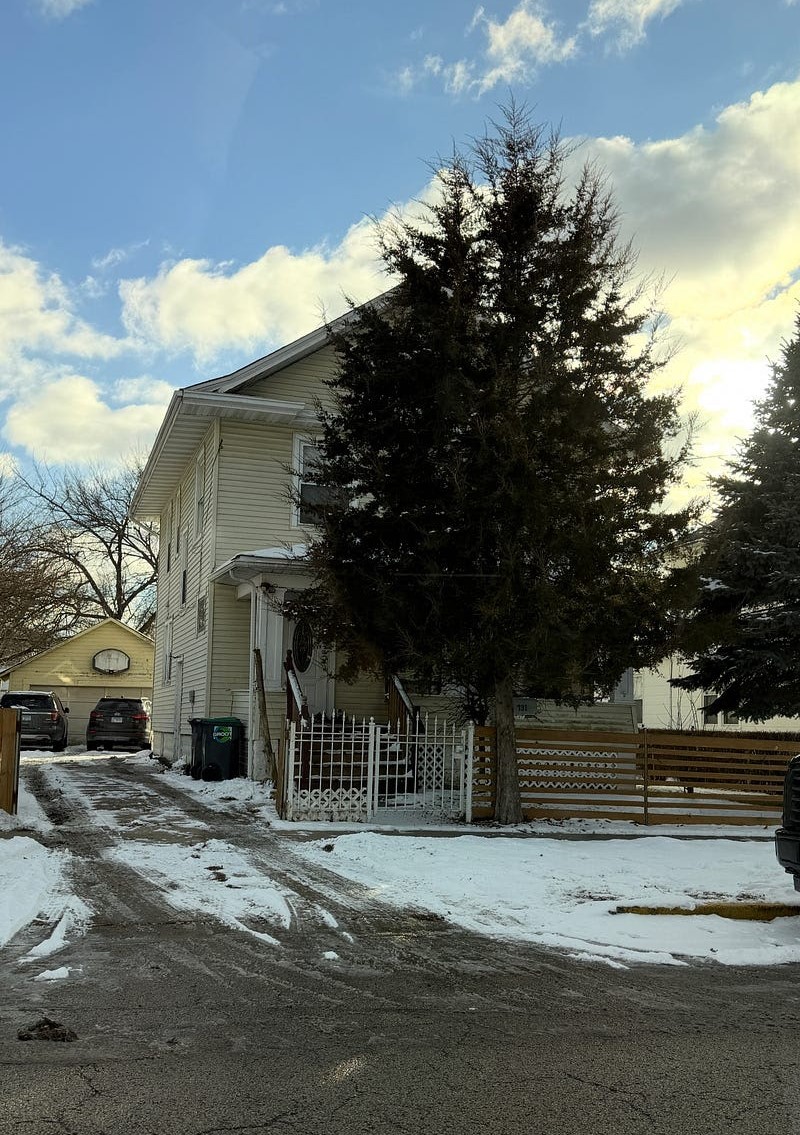
Our home was a century-old house at 731 Spring Street in Aurora, Illinois, and it was alive. I don’t mean that metaphorically. That house breathed. It creaked and settled and whispered through its old bones, and every room had a story embedded in its walls.
The attic smelled like dust, mothballs, and time. I loved exploring up there — rambling through old trunks and forgotten things, finding traces of the people who had lived in that house before us. Every object was a mystery. Every cobweb was an artifact.
The basement had an octopus furnace — the kind with tentacle ducts reaching in every direction — and it burned real fire. You could stand down there and feel the heat coming off it like the belly of something ancient and alive. Next to it was the old coal room, where coal used to be delivered through a chute window from the street. I remember the grit of coal dust on my fingertips, the cool darkness of that room, the way it felt like a cave inside our own home.
We watched Soul Train on Saturdays — studying the dancers, learning the moves, imagining ourselves in that line. We watched the Cubs on WGN, baseball games that stretched all afternoon with Harry Caray’s voice floating through the living room. We watched Love Boat on Friday nights, all of us together, the television glowing blue in the dark.
And down the street, there was a German bakery that filled the entire block with the smell of fresh bread and sugar. I can still close my eyes and smell it — warm yeast and butter and something sweet baking behind glass. And root beer barrels — those hard candies that tasted like autumn and Saturday errands. These are the textures of my childhood. Not just the arguments and the ambulances. The textures.
I loved my childhood.
Even with the drama. Especially with the drama.
One sparkling summer day when I was eleven, my father wrecked our brand-new car. A beautiful silver 1978 Buick LeSabre coupe with red velvety interior. He pulled the car crookedly into our long driveway, leaving it parked near the sidewalk where the neighbors got an unobstructed view. He was screaming for us.
My brother Walter and I ran outside. Walter was horrified and immediately ran to get Mother. I froze. My father was hanging on to the side of the car, stumbling toward us. His white T-shirt was soaked deep red from top to bottom. His arms and face were covered with red chunky muck. His curly brown hair was matted and clumped with shards of glass. Threads of red snaked down his forehead and neck like rivers on a travel map. He was missing a shoe.
My five-year-old sister, June, came careening around the corner of the house to the driveway and stopped cold in her tracks. She stopped so hard that her ponytails whipped all the way around her face. Scared into silence — which for June was rare — she stayed behind Mother and watched, still as a statue.
My mother came running in her blue cotton caftan, hollering his name. I was crying, praying, shaking. This was exactly the thing I had feared most — except in my imagination, someone would call on the phone to tell us he was dead, and I would faint or maybe die.
Mother went into nurse mode and began patting him, looking for the wounds. He grabbed her hands and pushed them away. “Good Lawd, woman,” he drawled. “I’m aaaaallllllright.” He paused. Then, with an exaggerated wave toward the car, he slurred loudly: “But ’dem tomatoes is throooough!”
Yes, he had wrapped the car around a utility pole at the corner of Hill and Benton. Yes, he was okay. No, the red stuff was not blood, but tomatoes his friend Willette had given him from his garden. My dad was a Bloody Mary.
It was too much drama for a little kid. But this was how the stage was set for me. This strange dichotomy of our lives — the juxtaposed seriousness and humor, the simultaneously horrifying and hilarious — almost never ceased. I felt even more responsible for my father after this episode. And my childish faith was secure, because I knew God was watching out for us. He had answered my prayers about my parents’ welfare. He had sent an answer in the form of an eleven-year-old child. He had sent me.
Even with the stress of early responsibilities. Even with an alcoholic father and an argumentative mother. Even with the sirens and the battles and the nights I prayed so hard my knuckles ached. I loved it. Because in between the storms, there was regularity. There was warmth. There was a family doing its imperfect best.
I only learned how to contextualize my parents’ relationship as I grew older. And the truth is, I am still learning. Still understanding their dynamics. Still discovering new layers of who they were as I attain the ages they were when I was watching them — except now I see it from an adult’s perspective.
Things that confused me as a child make sense now. The arguments were not just anger — they were exhaustion, they were fear, they were two people trying to build a life in a country that had never planned to let them succeed. Their fighting was not hatred. It was friction born from love under unbearable pressure.
And the truth was, I didn’t mind being part of a family that was sometimes broken and put back together. Like kintsugi — the Japanese art of mending broken pottery with gold, honoring the cracks instead of hiding them. Our family was kintsugi. The breaks were visible. The repair was imperfect. But the gold that held us together was real.
My parents were two imperfect souls doing the very best they knew how. Two people who stayed together, remained a team, even when society said they shouldn’t. Even when the drinking made it hard. Even when the arguments made the walls shake. They made me. They raised me in a home where I mostly raised myself, where seasons came and went, where we all more existed than lived. But we didn’t discard each other.
We did not discard each other.
My father eventually stopped drinking. And when he did, he became my buddy. Not the distant, troubled man who disappeared into bottles — but my friend. My confidant. The grandfather who would sneak candy to my kids when he thought I wasn’t looking. He and my children had the best, sneakiest, most loving relationship a grandchild could wish for. The kind of grandfather-grandchild bond that is built on winks and whispered conspiracies and an understanding that Grandpa’s rules were different from Mama’s rules, and that was perfectly fine.
See, when we can muscle up and get through the hard parts, there are rewards. We just don’t know what they will be. I didn’t know that the father who terrified me as a child would become the man who made me laugh harder than anyone. I didn’t know that the mother who dismissed my vision would become the woman I would nurse through four strokes and love until her last breath. I didn’t know that the broken parts of my childhood would become the gold in my own kintsugi.
My mother died in 1997. I was thirty years old. My father died in 1999. I was thirty-two. He was forty-four years older than me — born in 1923, a man from another era entirely — and I didn’t get nearly enough time with him. Especially not the version of him that had found sobriety, the version that sat on the porch and told stories, the version that my children adored.
I lost them both before I turned thirty-five. And I carried them both inside me from that point forward — their strength, their stubbornness, their refusal to quit on each other, and yes, their patterns. Patterns I would spend the next two decades either repeating or unlearning.
Not long before my mother died, she told me, “I should have held you more.” That sticks with me to this day. It meant she could feel a distance between us — the same distance she had felt from her own mother in Mississippi. And in one of our last real conversations, when I watched her struggling with her rehabilitation, she looked at me and said: “Don’t do that to yourself, Tracey. Don’t do it. You can run yourself into the ground if you want to. But the body wears out. I was so surprised, but my body wore out.”
She was warning me. And I didn’t listen. Not for thirty more years.
In our old house on Spring Street, there was a broken sash window — the kind that works on a pulley system. My father used to fix them, but after he lost his vision, he couldn’t anymore. So the window at the foot of my parents’ bed had to be propped open with a stick. You had to place the stick in the groove just right, or the window would slam shut. We stored the stick between the window and the screen so it wouldn’t go missing.
How fitting, I thought years later, that my parents began this journey as my stick in the window — and I grew and learned how to become theirs. Always stored handily between them where they could reach me, lest their window come smashing down. It was the greatest honor of my life to be chosen to prop them up when they needed it most. To stand on the wall, bringing in a breath of fresh air, many times, one for which we all were gasping.
And then my daughter took the stick and broke it over her knee.