Blog
What Dust Looks Like


Generational trauma in women is often a silent inheritance, felt in the air of a house before it is ever named or understood.
Grief has a smell.
Nobody tells you that. They hand you the five stages like a travel itinerary — as though mourning were a country with an orderly customs process, a known capital city, a return flight already booked. They do not tell you that grief is olfactory before it is anything else. That it reaches you through the back of the throat before your mind has made any decision about how to receive it. That it arrives in the coat still warm from someone’s body, in the soap they used, in the particular smell of a Sunday morning inside a house that no longer exists anywhere but inside you.
I know what June smelled like. I know the warmth of her presence in a room before I looked up to confirm she was there. I know the sound her laugh made when something caught her off guard — the involuntary, full-body kind you cannot manufacture, the kind that made everyone within earshot turn toward her like sunflowers do. I know her voice when she sang. Which was the truest version of her. The one she became when music asked something of her, and she gave it everything she had.
What I did not know was how to grieve her.
Because she was not supposed to go first.
• • •
We grew up in the same house on Spring Street in Aurora, Illinois, six years apart — which is the kind of distance that makes you two different generations of the same family. I was the oldest. I was the cartographer. She followed the map I drew without knowing I was drawing it, the way smoke follows the source of its heat without choosing to, without understanding the physics of its own movement.
Our father smelled like God on his good days — that particular aftershave that meant he had decided to show up, to be present, to be the man he was trying to become after the war had done what wars do to the men who survive them. Our mother moved through the house like a pressure front. You felt her before you saw her — a density in the air, a change in the light, a shift in the room’s frequency that meant everything was about to recalibrate. When she was warm, every room was warm. When she was electric, you felt it in your fillings.
We grew up on Soul Train Saturdays. We listened to the Rainbow Coalition screaming us to believe I AM SOMEBODY! And there were the Cubs games, sometimes marathons, on WGN and Harry Caray’s voice floating through the living room like an old, beloved spirit who had simply decided to stay. We grew up on the smell of the German bakery two blocks down, which exhaled sugar and yeast into the street every morning like a benediction we hadn’t asked for but needed anyway. We grew up in the basement next to an octopus furnace that breathed real fire and a coal room that felt like a cave at the center of the earth, gritty and dark and ours.
We grew up on love that was loud and imperfect and absolutely certain of itself.
But we did not grow up understanding how to receive that love without condition. How to hold ourselves the way we held each other — with the same ferocity, the same bottomless patience. That was not modeled for us. That was the gap no one named, the lesson that slipped through the curriculum of that loud, warm, imperfect house, and we carried the gap with us into our own lives the way you carry a draft — not quite cold enough to locate, not quite warm enough to ignore, but always there, finding the back of your neck.
• • •
My mother had older children. From a life before Spring Street, before Aurora, before us. Children I never really knew — half-siblings who existed at the edge of my awareness the way distant weather exists at the edge of a clear day. You know it’s out there. You don’t look directly at it.
I know this much: my mother went to Los Angeles once to visit one of her daughters. One of those older children. She came back different. Not loudly different — my mother was not a woman who announced her wounds. She was a woman who absorbed them and kept moving, the way the house on Spring Street kept standing through every winter. But I could see it in her. The way you see a crack in a foundation not by the crack itself but by the settling that follows it.
I learned it later. What had happened. What her daughter had said.
She told my mother she’d had to burn the sheets after she left.
Burn the sheets.
I have turned those three words over in my hands for years, the way you turn over an object you’ve found that you cannot identify, that seems too ordinary to be dangerous and too specific to be accidental. Burn the sheets. Not wash them. Not replace them. Burn them. As though my mother’s presence in that bed was a contamination to be purified rather than a visit to be remembered. As though the woman who had carried her inside her body had left behind something that required fire to undo.
What does that do to a mother?
I’ll tell you what it does. It becomes a bullet that never leaves. It doesn’t wound you once and scar over. It keeps moving through the body like the bouncing of a .22 caliber. You are ducking and dodging the rest of your life — flinching in the direction of your own children, never quite certain whether the love you are offering is being received as love or filed somewhere as evidence of something you don’t yet know you’ve done. Every knock of the door. Every phone that rings. Every holiday that approaches: is this the time they come back, or is this the time they confirm they have decided I am something to be burned away?
My mother carried that bullet until she died.
I watched her carry it and did not have the language for what I was watching. I was too young, and then I was too busy, and then I was inside my own version of the same story, moving in the same current, not yet understanding that currents have names and that ours had been running through this family for longer than I had been alive.
This is what I mean when I say it was generational. Not in the soft, therapeutic sense — patterns passed down, behaviors modeled, wounds inherited. I mean it the way a river is generational: the same water moving through different banks, carving the same channel deeper with each pass. My mother’s daughter burned the sheets. June’s children slowly, politely, completely disappeared. My daughter extracted everything available and called it a relationship. Three generations of women who loved without limit, who had never once been taught that a limit was not a failure of love but a condition of survival — and three generations of children who, somewhere along the way, learned that a mother’s love was a resource rather than a gift. That it could be used. That it did not require tending. That you could, if you needed to, burn what remained and call it clean.
We were not taught to say Fuck You to that. We were taught to keep the door open.
We were taught that the open door was who we were.
• • •
She sang at my wedding.
John Legend’s “Stay With You.” She stood at the front of the room and opened her mouth and the sound that came out was not a performance — it was a declaration. Her voice was a climate shift. The equatorial kind. The kind that moves through a room and changes its pressure entirely, that makes everything in it grow toward the source without deciding to. My heart heard her song before my ears did. That is what synesthesia is: when one sense crosses into another, when sound becomes something you feel in your sternum before you process it as music.
She meant every word. June always meant every word. She did not know how to love partially or provisionally. She loved the way that old furnace heated the house on Spring Street — from the center outward, filling every room, leaving no cold corner unattended.
Her dream was sacred in its simplicity: to be a mother and a wife. To fill a house with family. To bounce grand-babies on her knee one day and laugh that full-body laugh and have nowhere she needed to be except right there.
She achieved it. For a while.
And then, slowly — not all at once, never all at once, because the cruelest things never announce themselves — it was taken from her.
• • •
The marriage ended first. That gutted her. But she was built for survival the same way we both were, from the same materials, shaped by the same hands, and she rebuilt. She kept showing up. She kept her chin at that particular angle that said: I am not finished.
What she could not survive was the disappearing of her children.
Not a dramatic rupture. Not a single night when everything broke and you could point to the rubble and say: there, that is where it happened. It was quieter than that. More patient. The way erosion works — not a single blow but ten thousand small ones, each one unremarkable, each one leaving the surface slightly less than it was before. Fewer calls. Missed holidays. Excuses that multiplied into months that became years. The slow withdrawal of the people she had grown inside her body and poured herself into for decades, receding like a tide that one day simply does not come back in.
She kept their rooms ready. I need you to sit with that sentence. She kept their rooms ready. The beds made. The small details preserved. The door open for people who had quietly, without ceremony, closed theirs.
She paid their phone bills out of fear of losing permanent touch with them. And she checked her phone the way you check a wound — compulsively, hoping it has healed while you were not watching, finding it hasn’t, checking again tomorrow anyway. She waited at the table she kept set for a family that had learned, from somewhere, from someone, that leaving without explanation was acceptable. That a mother’s love was not a thing that required tending.
And here is the thing that knifes me open when I let myself look at it directly: she did not know she was allowed to say anything other than yes. She did not know she was allowed to name what was happening to her. She had learned — from the same curriculum that shaped us both, from the same house that loved loudly without teaching us how to love ourselves — that a woman’s worth lived in her endurance. That the open door was not a choice. It was the whole of her identity. To close it, even partway, even in her own defense, would have meant she did not love them enough.
Loving yourself is a disease in this family. That is not a metaphor. I mean it as a clinical observation about a pattern that ran through us like a genetic marker: the inability to locate ourselves as worthy of the same devotion we gave everyone else. An autoimmune disorder of the soul, in which the very mechanisms designed to protect us turned inward and attacked. We could love magnificently outward. We could burn ourselves down to a wick and hand the flame to anyone who reached for it. But love directed at ourselves? That was selfish. That was dangerous. That was the thing well-behaved women in this lineage did not do.
For ten years, June lived inside what psychologists call ambiguous loss. I found her therapy notes. Grief without closure. Grief with no body to bury, no moment to mark, no permission to stop hoping. The kind that loops and loops and never completes its circuit, that keeps the nervous system in a permanent state of anticipation, that wears the heart out the way water wears stone — not by force, but by time and repetition and the particular exhaustion of never being allowed to stop.
I could see it happening. I watched it from six years ahead of her on the same road, and I could see the cliff she was walking toward, and I did not have the words to stop her because I was walking toward my own.
• • •
Here is what I have never said out loud.
I was dying too.
Not loudly. Not in any way that would have appeared in a medical chart or shown up on a scan. I was dying the way women like us die — casually, in the middle of our own lives, still answering emails and returning calls and being the stick in everyone else’s window while our own frame was coming apart at every joint. I was being consumed by my daughter the way a fire consumes paper — not all at once but steadily, from the edges inward, until what you believed was the whole page was really just the ghost of one.
My daughter is a narcissist. I use that word with precision, not with rage, not as a convenient label for a difficult person, but as the most accurate clinical description available for a particular pattern of behavior that I lived inside for years without a name for what was happening to me. The manipulation. The financial exploitation. The rewriting of history. The way love was offered and withdrawn as a management strategy rather than as a human act. The particular exhaustion of loving someone who experiences your love as a resource to be extracted rather than a gift freely given.
I had learned, the same way June had learned, the same way our mother before us had learned — the same way her mother’s daughter had pressed a flame to a mattress and called it hygiene — that love was a verb requiring constant, costly, unconditional action. That a woman’s value was measured by how much she gave and how little she asked for in return. That keeping the window open for everyone else was not just noble — it was who we were. It was the whole of it.
Three generations. Three women. The same river, carving the same wound deeper.
And so, I gave. And gave. And kept giving past the point where giving was possible. And the edges of me caught fire and I did not notice because I was too busy making sure everyone else was warm.
• • •
June died on January 3rd, 2026. The same date I had first met her — the pink baby carried through the front door, my first doll, my first responsibility, the beginning of everything.
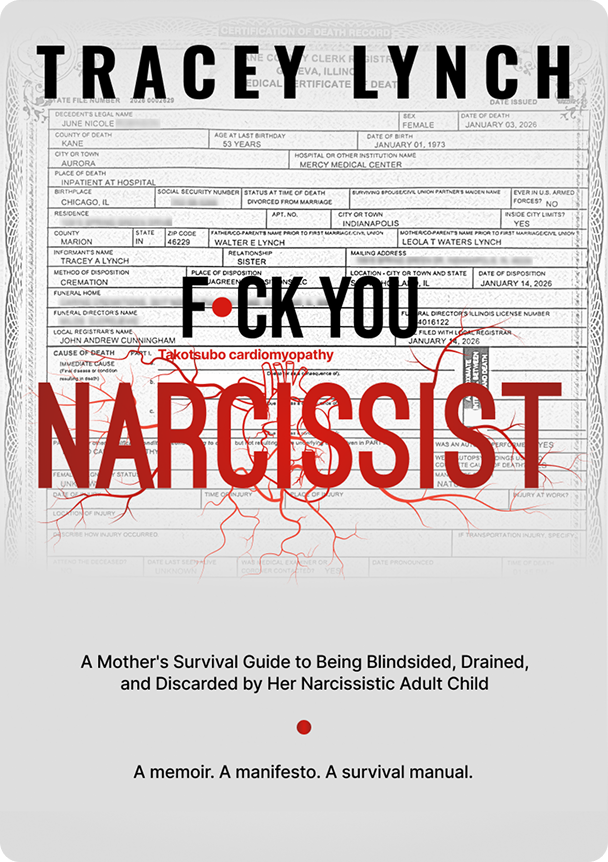
She was fifty-three years old. Her heart stopped. That is what was written down.
What was not written down was the decade of waiting that preceded it. What was not named was the particular cardiac event that cardiologists call Takotsubo cardiomyopathy — Broken Heart Syndrome — first identified in Japan, documented now in medical literature across the world: an overwhelming emotional stress that causes the left ventricle to balloon and weaken, the heart literally changing its shape under the weight of grief that has been carried too long without relief. It is a real diagnosis. It is a real cause of death. It is what happens when the body finally tells the truth about what the mind has been refusing to name.
June did not die of natural causes. June died of ten years of unnatural ones.
And somewhere in Los Angeles, there was a set of sheets that had already been burned.
And I stood holding the ashes of my sister in my hands and felt the full length of the thread that connected every woman in my family who had ever loved past the point of return — who had held the door open until their arms gave out, who had kept the rooms ready, who had checked the phone the way you check a wound, who had let their children define their worth and then been consumed by the verdict. I held her ashes and I understood, with the particular clarity that only loss this size can produce, that I was standing at a crossroads that had been built over three generations: one road continued the pattern. One road ended it.
When she left, the smoke cleared.
Not a gentle clearing. An acrid one. The kind that singes your eyes and forces them open. I had been moving through the fog of my own story for years — believing I could see because I could see the road immediately in front of me — and her death cut through every narrative I had been maintaining about why things were the way they were and who was responsible and what a good woman does when the people she loves treat her as though she is something to be managed, extracted, or burned away.
She died before me. She handed me the baton. She gave me the years she didn’t get and the understanding that I could not afford to spend them the way she had spent hers. She gave me, in her absence, what she had tried to give me in her presence: the truth.
And the truth, when I could finally stand in it without flinching, was this: I had been living inside the same disease. The same inherited inability to love myself with the same ferocity I extended to everyone else. The same quiet conviction that my needs were secondary, my pain was negotiable, my worth was contingent on what I was willing to endure. I had learned this at Spring Street. My mother had learned it somewhere before that. Her daughter had learned something entirely different — that the women in this family were for using, that love from us did not require reciprocity, that you could burn the sheets and still consider yourself the wronged party.
I was done being that kind of woman. I was done passing that curriculum down.
What began as grief became something harder and more specific and more necessary. It became a reckoning. It became the slow, unglamorous, non-cinematic work of understanding exactly what had been done to me, and exactly what I had done to myself by participating in it, and exactly what it would cost to stop. It became the book. It became the title I did not choose carefully or strategically but found waiting for me, already fully formed, the morning I finally said out loud what I had been circling for years:
Fuck you.
Not to June. Not to my mother. Not to my grandmother I knew and those I never met whose lives I will never fully know. To the pattern. To the inheritance. To the silent, generations-long agreement that a woman in this lineage puts herself last and calls it love. To every version of the story that ended with a good woman’s heart stopping because no one — not even she herself — had been willing to say: this is enough, I am enough, I will not give what I do not have, and I will not die for someone else’s comfort.
Fuck you to the idea that keeping the door open is the same as being worthy of love.
Fuck you to the disease.
• • •
They say there are five stages of grief. Denial. Anger. Bargaining. Depression. Acceptance.
What they do not name is the sixth stage, the one that lives underneath all the others: the longing for a different ending.
I longed for it so fiercely that some mornings it sat on my chest like a physical weight. I longed for the version of the story where her children came back in time. Where someone named what was happening to her before her heart ran the calculation and came up short. Where I had said something sooner, something truer, something that cut through the silence we both kept out of love and out of the particular female conditioning that teaches women to absorb rather than confront.
I bargained with the past the way you bargain with a locked door — trying every key you have, and then some you improvise, and then simply pressing your palm flat against the wood as though warmth could open what logic cannot. The door does not open. The ending does not change. June does not come back through it.
What comes through it instead, eventually, is something harder and quieter and more useful than the ending I wanted: the understanding that her story is now mine to carry. That the silence that surrounded what happened to her — the silence that called it natural causes and moved on, that called my mother’s burning sheets a private family matter, that called my daughter’s extraction of me a complicated relationship — is the same silence that is happening to women everywhere right now, today, as you read this. Women who are being worn down by the people they love most. Women who are keeping their children’s rooms ready while their own rooms are going dark. Women who are dying of broken hearts and being buried under the phrase: she was always so devoted.
I will not be silent about it. I was not built for silence. I was built for Spring Street and coal rooms and the furnace that heated from the center outward and the bakery that fed the whole street whether it meant to or not. I was built for this.
• • •
Here is what I know at fifty-nine that I did not know at forty-nine, or thirty-nine, or twenty-nine:
Breaking is not the end. I know this not as a comfort I have borrowed from someone else’s wisdom but as a fact I earned. I was broken. My edges were sharp and findable. I gathered them. I had help gathering them — the hard, patient, unglamorous kind of help that comes from finally being honest about what has been happening and what it has cost. And the pieces, when fitted back together, made something that holds more than the original did. Something that has learned the places where it can crack and been fortified there. Something kintsugi. Something gold at the seams.
I am not hardening. I am becoming whole.
June could not do that. What came for her did not crack her — it eroded her, slowly and completely, until there was nothing left to gather. I held her ashes in my hands and felt the full weight of that truth: she had been made too fine to hold. That is not her failure. That is the nature of the force that found her. And the name of that force — the thing that ground her down without a single visible blow, the thing that made her children strangers and her heart a liability, the thing that began in a house I never knew with a daughter I never met pressing a match to a mattress — is the thing I am writing about now, in the book I owe her, in every word I set down as long as I am able.
The grief is permanent. I want to be honest about that. Anyone who tells you that healing means the grief goes away has not loved someone the way I loved June. The grief stays. It changes its weight and its texture over time — it becomes less a wave that crashes and less a pattern that you dread and more a tide chart you have finally memorized. You know the markings. You can sometimes feel it pulling at your blood hours before it arrives. But it stays. She stays, inside it.
What also stays — what I did not expect to survive alongside the grief — is the joy. Not despite what happened. Because of what I chose to do with it. The garden I tend with my hands in the soil and the dirt under my fingernails and the particular satisfaction of watching something green push up through earth that was cold last week. The books my husband and I read aloud to each other in the evening. The three small dogs who have strong opinions about everything. The work that finally, at fifty-nine, is the right work — the work I was sent here to do, the work that uses every hard thing I have survived as material rather than weight.
The work that names the disease.
The work that breaks the river’s channel.
June handed me the baton. I am still running.